Showing posts with label esteli. Show all posts

Monday, May 18, 2015

4/5/86

4/5/86, Saturday

Last night we had a frightening experience. Some time between 11:00 pm and midnight, we heard machine gunfire going off somewhere in town. The shooting continued erratically for about an hour while I lay in my bed, feeling scared. I thought the town was under siege. I had to pee desperately but I have to go outside to get to the bathroom, so despite the fact that I was terrified of leaving my bedroom, I quietly walked outside and then tiptoed back again. After awhile, the shooting died down and I was able to sleep a little but I had a pretty good scare.

This morning, nobody seemed to be quite sure what the machine gunfire was all about. My Nicaraguan mother, Francie says she got up and got dressed in case we had to evacuate in a hurry. She is perplexed, she says it may have just been a bolo (drunk) having war flashbacks. Luckily, two of my little sisters slept through the incident. Anyway, the real attack came from the bugs. I’m covered with bug bites despite the sleeping bag, repellent, and mosquito netting. C’est la vie.


Contra (Counter-revolutionary soldier) attacks were very common in Northern Nicaragua during this time period, so people throughout Esteli had legitimate cause to be concerned about their safety. 


Around this time, Sister Nancy Donovan, a Catholic nun who was working in Esteli was captured by Contras while enroute to the nearby town of Limay. Nine people who were traveling with her were slain. She later told her story and related some of her conversations with her captors: 
Sister Nancy: "You people always complain that, with the revolution, there’s a scarcity of certain things; so, why did you burn our vehicle? " 
Contra: "Because it belonged to the state." 
Sister Nancy: "Ask the people from Limay, and they’ll tell you: that was our bus."  
Contra: "No, that bus didn’t belong to the people. If it had, nobody would’ve had to pay." 
Sister Nancy: "Why do you kidnap and kill people?" 
Contra: "We only do that with Sandinistas and the ones who belong to the army." 
Sister Nancy: "But we weren’t with the army." 
Contra: "You’re all Sandinistas." 
Sister Nancy: "Are you going to let me go?" 
Contra: "Is this the first time you’ve had any contact with us?"
Sister Nancy: "Yes."  
Contra: "I bet you thought we were no good." 
Sister Nancy: "It’s not up to me to judge anyone. All people have their own conscience. What’s important are their acts." 
Contra: "We only harm the Sandinistas. The revolution’s evil; it’s communist and atheist."  
Sister Nancy: "How do you know that?" 
Contra: "Before we never had to line up with a card to get sugar. That’s communism." 
Sister Nancy: "And how do you know that the revolution is atheist?" 
Contra: "The nine comandantes are against religion." 
Sister Nancy: "But have you people had any problems practicing your religion?" 
Contra: "No, not us."
Sister Nancy: "Well, I’m a nun, and the only problems I’ve had have been with you people, in places where you’ve been."
Sister Nancy added: “The counterrevolutionaries who were holding me had very good uniforms. The majority of them had the letters ‘FDN.’ One had ‘US Army’ on his arm, and another ‘Soldier of Fortune, Second Convention.’ Everything they had seemed quite new. One of them said to me: ‘There’s a plane that comes by very quietly in the night and drops us really good provisions.’ ” 


Source articles and more information here: 

http://www.nytimes.com/1985/01/11/world/us-nun-detained-briefly-by-rebels-in-nicaragua.html
http://www.envio.org.ni/articulo/3391

Friday, May 8, 2015

4/2/86, Wednesday


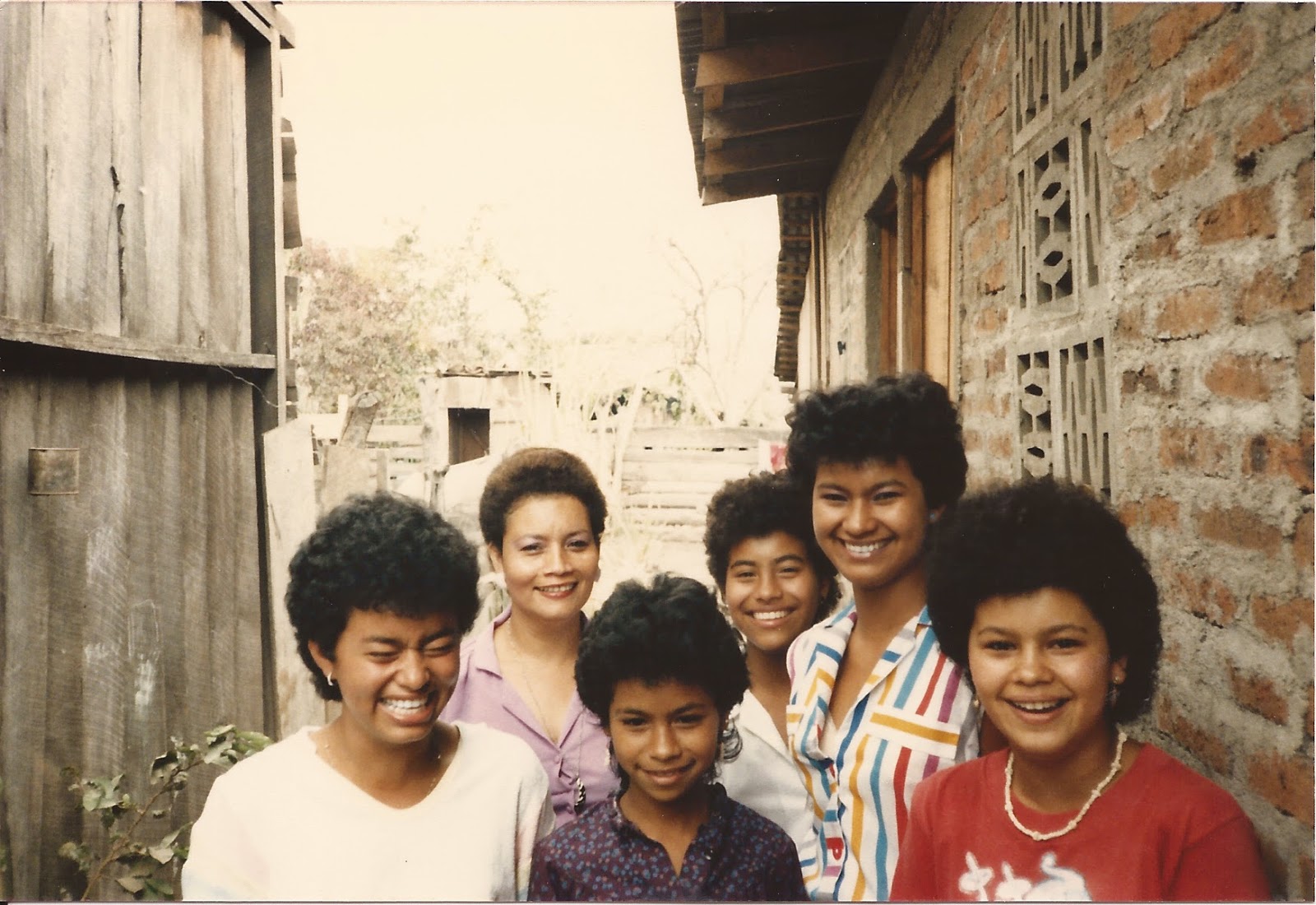
My Nicaraguan Family:
Front row: Paca, Milche, Carelia
Back row: Francie, Lissette, Magda

4/2/86, Wednesday


I wasn't able to shower in Managua and last night it was too late when I finally got to our house in Esteli. Plus, everyone wanted to get to know me and I wanted to talk to them, so I waited. This morning I finally got my shower. It was a chilly experience. The water never got warm so I took about a one minute shower, soaping up my entire body before turning on the cold stream for a frigid rinse. Despite these things and many other inconveniences of living with people at this level of poverty, I’m very glad to be here. It’s not that big a deal to have to do without the luxuries we have back home. Oddly, having to adapt so quickly makes me feel like an alarm clock went off in my body and soul. It’s like my whole being took a cold shower.

Yesterday I was introduced to my Nicaraguan family. It’s an all female household. Five daughters live at home and one lives in Managua. The girls all work together to manage the house until their mom gets home from work.

Adrianna is the youngest of six daughters. She’s quite thin, sweet, playful and soft spoken. She has a wild mane of messy, curly hair. I’m guessing that she’s about 7 years old.

Next is Milche, she is only a little older than Adrianna, she’s quiet, reserved, and very attentive.

Lissette, who picked me up yesterday at the Nica school, is the middle daughter. I find her charming and outgoing... a little rebel.

After that is Paca, she’s just a teenager but she’s cultivated a maternal attitude towards the younger girls and they definitely take direction from her.

Carelia is a beautiful, young high school age lady. She’s not that interested in dealing with her younger sisters, probably because she has a boyfriend named Lenin who Lissette says takes up all of her time. (He already came by to say hello.)

Magda doesn't live at home, she’s the oldest daughter. She’s married and lives in Managua.

My Nicaraguan mother’s name is Francisca Dormus Zea but I heard one of the neighbors call her Francie and I like that better. I mentioned the nickname and she insisted I call her that. She’s in her mid to late thirties, a former guerrilla, with a stern countenance. Yesterday, when she first walked up to greet me she had a serious look on her face but it only took a couple of seconds for it to break into a smile. She apologized for working late and it dawned on me that she was probably just tired. We enjoyed a simple dinner of beans and tortillas and then she and I sat in the living room to talk. She wanted to know everything about me but as I told it, I found my story to be rather dull. I wanted to hear her story and after awhile she shared it.

Francie is a strong, well-informed, intelligent woman with incredible vitality. She’s part of a women’s military reserve battalion but a lot of her time is spent doing what she calls social work. I don’t know if she’s an actual social worker but it sounds like she’s mostly concerned with the welfare of women, making sure their needs and interests are addressed. As I listened to her, I could tell that she cares deeply about making sure that women feel involved and participate in the revolution.


Alice, Lenin and Francie

“It would be very easy for women to fall back into traditional roles,” she tells me. “Many of the women in Esteli were active in trying to overthrow Somoza but to different degrees and in
different ways. For those of us who were integrated in the struggle, it allowed us to see ourselves in a new way. During the seventies, women combatientes were risking their lives, the same as the men soldiers. We thought of ourselves as equals but even though we were doing the same things they were doing, we still had to put up with machismo from other soldiers, husbands, brothers...”

Her voiced trailed off and I wondered if she was remembering a particular macho comment that might have wounded her. Francie sat quietly in front of me, dressed in an olive drab shirt and pants. Her legs were spread open in front of her in a pose that I had always associated with men, her body relaxed and open, completely in control of her presence and ready to act at any moment. There was a hardness to her look but a quality of gentleness in her eyes. I studied her face, noticing her earrings and a hint of lipstick. I saw a woman for whom strength and femininity were whatever she wanted them to be. She gazed off into the distance for a minute, temporarily lost in thought.

I said nothing to break the silence. Finally, she sighed and smiled at me. I wanted to know more about this matriarch but I instinctively knew not to pry.

My Nicaraguan family has been very involved (or integrated, as they say here) in the revolutionary and post-revolutionary movements. They are a rich source of history and firsthand information. Even the house we’re living in seems to have a story to tell. It was used as a Sandinista headquarters and some of the leaders lived here while in Esteli. We were still seated in the living room when I happened to look at the painting that was hanging behind Francie’s head. It seemed religious at first glance but there was something off about it.

“Is that a picture of Jesus?” I asked, standing to take a closer look. The lean, dark-skinned, bearded man in the painting had a rifle dangling by his side but there was a look of peace emanating from his eyes and he appeared to have a bright amber halo over his head.

Francie laughed. “In Nicaragua, even Jesus carries a rifle.”


Jesus con fusil