Wednesday, May 13, 2015

4/3/86 PM, Thursday

4/3/86 PM, Thursday


I wait in the classroom where there are five chairs and four tables of assorted heights, shapes and sizes. Soon students of all ages, from children to adults start to trickle in. They greet each other warmly. Some carry chairs, the early birds snag one of the five available chairs while others resign themselves to a lesson on foot. 


A man in coveralls has apparently come straight from work. His clothes and hands look dirty but no one seems to mind. A woman comes in with an infant in her arms and a little girl pulling at her skirt. One of the early birds offers her his chair but she declines, choosing instead to sway with her baby at the back of the room while the little girl goes out to play with some of the other children who are waiting for their parents to attend class. 


Lorraine Scognomillo, 2015

This group is on Lesson Ten. The teacher writes the following sentence on the board: La reforma agraria recupera la producción de la tierra para el pueblo. (Agrarian reform recovers the land for the use of the people.) She reads aloud, then the students join her. Discussion ensues as she reminds the class that they are waiting for everyone to get there. I walk around, eavesdropping on the little groups clustered around the tables. Some are discussing the sentence, others are still catching up with each other about what happened during their day. 

After a while, the little classroom is full and dialogue fills every corner. The woman with the baby joins a round table, still swaying as she interjects with her opinions. The teacher reads the sentence again, placing an open palm under each word as she reads it. “La reforma agraria recupera la producción de la tierra para el pueblo.” Some of the students join her, others just listen. Then she asks if anyone has any comments about the sentence. One man jokes, “I didn’t know I’d been robbed until right now!” Other joking comments follow and then more serious observations about Somocismo, about which types of crops are most beneficial. Everyone who wants to speak is given the opportunity. Differing views are expressed but the feeling of mutual respect is always there, modeled by the teacher and followed by the students. 

Soon the teacher leads the class back to the sentence and underlines the word recupera. The class reads it. She breaks it into syllables and pronounces each one, again placing her palm under each syllable as she reads it, re-cu-pe-ra. The class joins her. Next she underlines the syllable re. She makes the sounds of the letter r, gently rolling it off her tongue. 

“What other vowels can we combine with this letter?” she asks the class. The woman with the infant quickly calls out “ru-ru-ru!” The class bursts into laughter as the ru-ru-ru sound is often made by mothers who are trying to coax their babies to sleep. Her baby has just started to make soft, whimpering sounds. 

Ru, ru, ru! Con u, u, u,” the teacher calls back. The formal phonics lesson continues as the new syllables are constructed with the previously introduced consonant and vowels. 

It makes a lot of sense to me to have the students go from understanding the meaning of a sentence and how that message pertains to their lives to breaking down the words into syllables and letters. They understand the power of written language to transmit ideas. To learn to read and write is to harness that power. 

Even after the class is over, the dialogue component of the lesson has a lasting effect. Some of the students linger to chat, eager for the opportunity to share their ideas. The subject of discussion is not limited to the contents of the primer, it only begins there. Individual, community, national, and international concerns are all valid subjects for discussion and collective actions are encouraged. Everyone is expected to exchange viewpoints in a setting that encourages respect, fosters community and promotes praxis, breaking down the separation between theory and practice. 

I have just one gripe. Despite the fact that the ruling party - the FSLN - is extremely popular, the party is too repeatedly mentioned in the school books in comparison with opposition parties, who are rarely (if ever) mentioned at all. I think it’s important to have balance and consider different points of view. The problem is that the coalition of armed forces that opposed Somoza banded together under the name FSLN but after they overthrew him, the coalition disbanded and formed different parties with divergent political and economic ideologies. They all opposed Somoza and that had forced them to work together but once he was gone, the differences between them became evident, so the FSLN of a few years ago is a different entity from the FSLN today. 

Nonetheless, the literacy program is impressively efficient. It has a wonderful success rate and I believe there are many aspects of it which I can implement in my own teaching back home.

NICARAGUA

In Boaco, a small town south of Managua. The students are obliged to bring their own chairs due to lack of furniture in many schools. 

© 1986 Peter Williams 

Monday, May 11, 2015

4/3/86, Thursday

Adrianna

This morning Adrianna, the youngest of my little Nicaraguan sisters, took me on a trek to a school across town to distribute some of the supplies I collected in the U.S. The school is called Jose Benito Escobar, after a guerrilla combatant who was killed by Somoza’s Guardia here in Esteli. Adrianna told me that Comandante Escobar used to live in the house where our family lives now. We delivered our supplies to some very happy teachers who promised to put them to good use. The school was not yet open, so we didn’t hang out for long. We also knew that we had a long walk back and the sun was already beating down on us. On the way back we stopped for some gaseosas (as carbonated drinks are called here), it was a nice treat for Adrianna. I’m amazed that someone so young knows her way around town. I must learn from her. She never complained about the heat or the fact that our sweaty skin was the perfect surface for the dust to adhere.

When we got home, I made the mistake of postponing my shower in hopes that the water would warm up by early afternoon but it was unexpectedly turned off. Now that the water’s off, I guess I’ll have to stay dusty until tomorrow. There is water rationing here, just like in Managua but I haven’t figured out the dates and my family says it’s not uncommon for it to be turned off without warning.


Paca, looking confident and beautiful 

Later this morning I folded some clothes with my teenage sister Paca while she did the ironing. It was our first time alone together and felt like a perfect opportunity to chat. I noticed that she had some torn magazine pages taped on the wall. Among them was a photo of a woman wearing a gray head scarf and a plain gray work smock; next to it was a page from a fashion magazine featuring a woman with a huge mane of curly blonde hair. The two photos seemed incongruous next to each other, so I asked her about them. She started telling me about her trip to Cuba. She said she was rethinking how she defined beauty and explained that at one point, her wall had been covered with images from magazines of women whose lifestyles had nothing to do with hers, like the one of the woman with blonde hair. They were images from the same magazines I had grown up with, which featured predominately Caucasian women in expensive clothes.

Paca carefully ironed the cuffs on Lissette’s Bermuda shorts, made sure the fold on both legs was even, and continued with her story. “I like their straight hair, but mine has very tight curls.” She twisted a curl between her fingers. “And their skin looks so smooth.”

“They never have mosquito bites!” I added, scratching one of mine.

“Their skin is milky white, like they’ve never gone out in the sun.”

“Maybe they haven’t. It takes a lot of work to look like that.”

“My mom says they alter the photographs to make them look perfect.” 

“They do,” I reassured her. Then Paca dropped a bomb.

“But why is THAT considered perfect?” She pointed at the big-haired blonde. I had never considered that question. I knew the standards were impossible but I never wondered who set them or why certain features were considered beautiful. I was momentarily sent back to my childhood, remembering adults in East L.A. cooing over a child with guerito features. Kids could be ugly as sin but if they had light skin, eyes or hair they would receive heaps of praise. I had never understood it.

Paca finished with Lissette’s shorts, moved on to Francie’s uniform pants and meticulously creased them. Taking the tip of the iron, she gently tapped each pleat with it, pressing love into her family’s clothing, enacting the type of beauty she knows she possesses, the type that is now on her wall - the beauty that comes from a sense of purpose. “When I went to Cuba, I saw women who looked more like me. They were beautiful. They were average working women, not models,” Paca said. “It was my mom’s idea to put up the picture of the factory worker. Now, when I see images like this one,” she gestured to the ultra-thin, airbrushed model, “I realize I can never look like them and I’m starting to understand that that’s okay.”


Seeds for Germination 
Beauty in fashion magazines does not reflect or validate the average working woman, especially if the woman is not Caucasian. Learning to accept an appearance that is seldom validated takes ongoing conscious effort. The pressure intensifies as we get older when not only your ethnicity or body type can be portrayed as unattractive but when the natural process of aging is depicted as something ugly that needs to be avoided or corrected. 


When it comes to the household, Paca is second in command. She organizes the kids to help with the chores when Francie is at work. The whole family pitches in, since Francie is the sole breadwinner and it takes teamwork to keep things running smoothly. Paca cooks most of the meals when Francie is away. Yesterday, she cooked a very strange dinner for us, a big bowl of mashed tubers that looked like purpley-gray mashed potatoes. I’m not sure what it was called. We all ate it even though it was rather bland.


Lissette helps with the laundry

Noticing that I hadn’t eaten much, Lissette took the opportunity to introduce me to posicle. We walked a few blocks to an ordinary looking house with no signage. Lissette knocked and after a few minutes an older woman cracked the door open and peeked at us. “Hay posicle?” Lissette inquired. 

The old woman smiled and opened the door all the way to reveal a waist high freezer. "Si hay,” she replied in a friendly manner. I still wasn’t sure what we were getting. Posicle sounded a lot like Popsicle and the freezer seemed to confirm my suspicions but I was willing to be surprised. I gave Lissette the money and let her order for us. She handed the money to the woman who gave her two plastic sandwich bags with something reddish purple frozen inside. We thanked the woman and said goodbye.

Lissette handed me the posicle. I stared at it. “I’ll show you how to eat it,” she said. She grabbed a corner of the Baggie, squeezed and twisted it to create a sort of handle, then she bit of the opposite corner of the plastic bag and spit it out onto the street. I followed her example. “Now you just suck it out through that corner.”

“What is it?” I asked.

“Frozen grape punch,” she said immediately, putting the corner of the bag in her mouth.

“You said it was hard to describe,” I teased.

“Well...I thought I should show you how to eat it,” she smiled. Later that evening, she showed me how to eat banana sorbets.

It’s not always easy finding stuff to snack on, which is trying for someone like me who’s used to grazing all day. It seems like one of the most popular Nicaraguan sayings is no hay (there isn’t any). You walk up to a cafe and they’ll have a chalkboard out front with that day’s offerings, except that as the day progresses, you tend to find no hay handwritten next to many items. Often, they don’t even bother with the no hay. You sit down, thinking you’ll order something that caught your eye and you’re stuck with Gallo Pinto... again! The one thing there is plenty of is sugar. Nicaraguans eat more sugar than even a sweet freak like me can handle. It typically comes in the form of frescos, which are usually just a combination of fruit, sugar and water. My favorite fresco is avena, which is a finely ground oatmeal that is soaked in sugar water and cinnamon, it’s sooooo good!

I wonder if consuming all that fresco makes one’s blood sweeter. Well, at least I know the mosquitos are eating well! If it wasn’t for the mosquito net, I’d have been eaten alive. Just now, as I’ve started to complain about the mosquitos, I spied a visitor in my room. I don’t want to be a baby about this but there’s a big lizard crawling on the wall and I’m scared. I’m going to try to ignore it, maybe it’ll leave soon...hmm, it’s not leaving. I guess I’m going to go read in the other room for a little while. I’ve been lent lots of books and I haven’t had time to read them.


Friday, May 8, 2015

4/2/86, Wednesday


My Nicaraguan Family:
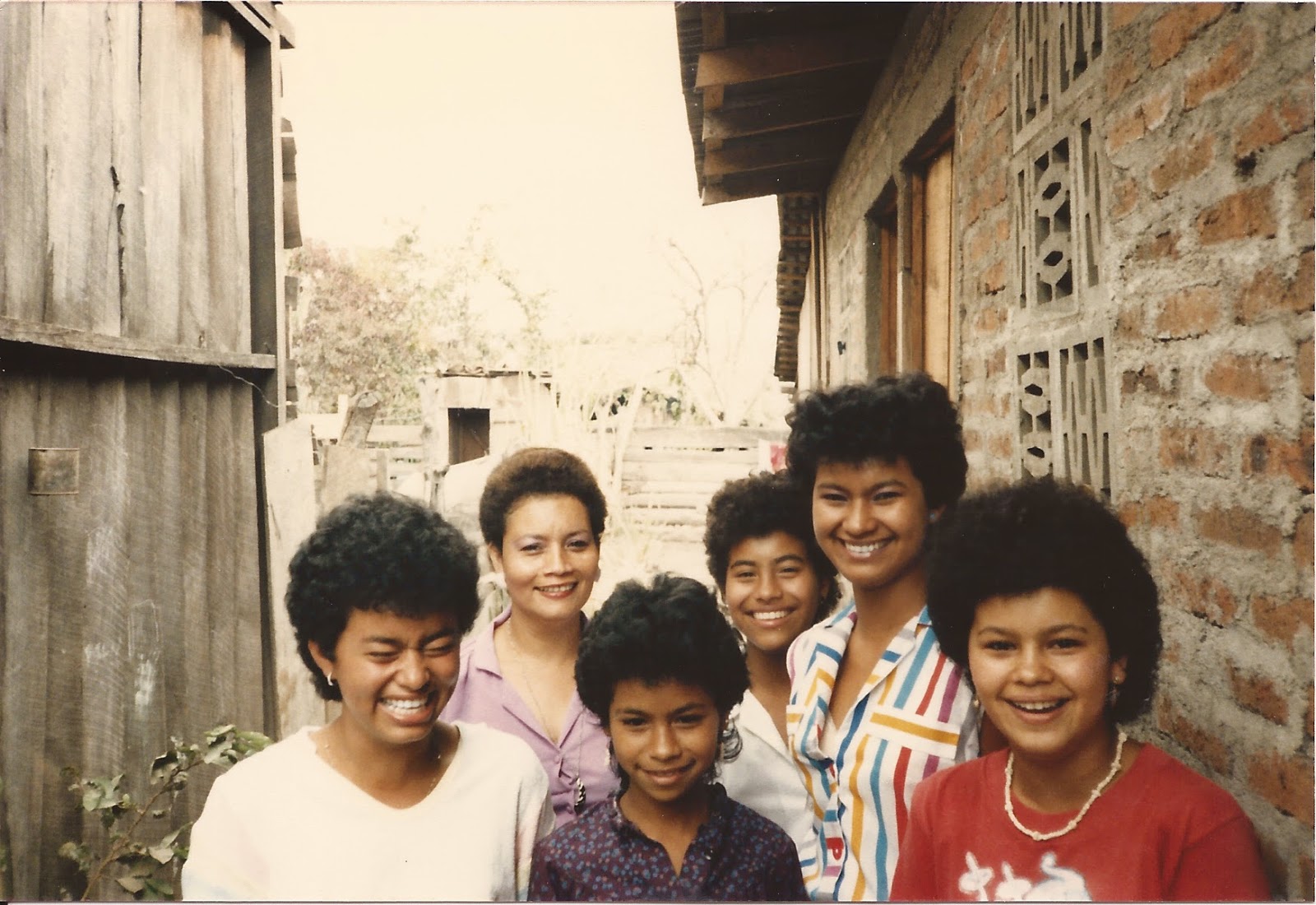
Front row: Paca, Milche, Carelia
Back row: Francie, Lissette, Magda

4/2/86, Wednesday


I wasn't able to shower in Managua and last night it was too late when I finally got to our house in Esteli. Plus, everyone wanted to get to know me and I wanted to talk to them, so I waited. This morning I finally got my shower. It was a chilly experience. The water never got warm so I took about a one minute shower, soaping up my entire body before turning on the cold stream for a frigid rinse. Despite these things and many other inconveniences of living with people at this level of poverty, I’m very glad to be here. It’s not that big a deal to have to do without the luxuries we have back home. Oddly, having to adapt so quickly makes me feel like an alarm clock went off in my body and soul. It’s like my whole being took a cold shower.

Yesterday I was introduced to my Nicaraguan family. It’s an all female household. Five daughters live at home and one lives in Managua. The girls all work together to manage the house until their mom gets home from work.

Adrianna is the youngest of six daughters. She’s quite thin, sweet, playful and soft spoken. She has a wild mane of messy, curly hair. I’m guessing that she’s about 7 years old.

Next is Milche, she is only a little older than Adrianna, she’s quiet, reserved, and very attentive.

Lissette, who picked me up yesterday at the Nica school, is the middle daughter. I find her charming and outgoing... a little rebel.

After that is Paca, she’s just a teenager but she’s cultivated a maternal attitude towards the younger girls and they definitely take direction from her.

Carelia is a beautiful, young high school age lady. She’s not that interested in dealing with her younger sisters, probably because she has a boyfriend named Lenin who Lissette says takes up all of her time. (He already came by to say hello.)

Magda doesn't live at home, she’s the oldest daughter. She’s married and lives in Managua.

My Nicaraguan mother’s name is Francisca Dormus Zea but I heard one of the neighbors call her Francie and I like that better. I mentioned the nickname and she insisted I call her that. She’s in her mid to late thirties, a former guerrilla, with a stern countenance. Yesterday, when she first walked up to greet me she had a serious look on her face but it only took a couple of seconds for it to break into a smile. She apologized for working late and it dawned on me that she was probably just tired. We enjoyed a simple dinner of beans and tortillas and then she and I sat in the living room to talk. She wanted to know everything about me but as I told it, I found my story to be rather dull. I wanted to hear her story and after awhile she shared it.

Francie is a strong, well-informed, intelligent woman with incredible vitality. She’s part of a women’s military reserve battalion but a lot of her time is spent doing what she calls social work. I don’t know if she’s an actual social worker but it sounds like she’s mostly concerned with the welfare of women, making sure their needs and interests are addressed. As I listened to her, I could tell that she cares deeply about making sure that women feel involved and participate in the revolution.


Alice, Lenin and Francie

“It would be very easy for women to fall back into traditional roles,” she tells me. “Many of the women in Esteli were active in trying to overthrow Somoza but to different degrees and in
different ways. For those of us who were integrated in the struggle, it allowed us to see ourselves in a new way. During the seventies, women combatientes were risking their lives, the same as the men soldiers. We thought of ourselves as equals but even though we were doing the same things they were doing, we still had to put up with machismo from other soldiers, husbands, brothers...”

Her voiced trailed off and I wondered if she was remembering a particular macho comment that might have wounded her. Francie sat quietly in front of me, dressed in an olive drab shirt and pants. Her legs were spread open in front of her in a pose that I had always associated with men, her body relaxed and open, completely in control of her presence and ready to act at any moment. There was a hardness to her look but a quality of gentleness in her eyes. I studied her face, noticing her earrings and a hint of lipstick. I saw a woman for whom strength and femininity were whatever she wanted them to be. She gazed off into the distance for a minute, temporarily lost in thought.

I said nothing to break the silence. Finally, she sighed and smiled at me. I wanted to know more about this matriarch but I instinctively knew not to pry.

My Nicaraguan family has been very involved (or integrated, as they say here) in the revolutionary and post-revolutionary movements. They are a rich source of history and firsthand information. Even the house we’re living in seems to have a story to tell. It was used as a Sandinista headquarters and some of the leaders lived here while in Esteli. We were still seated in the living room when I happened to look at the painting that was hanging behind Francie’s head. It seemed religious at first glance but there was something off about it.

“Is that a picture of Jesus?” I asked, standing to take a closer look. The lean, dark-skinned, bearded man in the painting had a rifle dangling by his side but there was a look of peace emanating from his eyes and he appeared to have a bright amber halo over his head.

Francie laughed. “In Nicaragua, even Jesus carries a rifle.”


Jesus con fusil

Wednesday, May 6, 2015

4/1/86, Tuesday

4/1/86, Tuesday

Welcome to the Norma.

After rounding up the Escuela Nica students and volunteers at the airport, the school representative dropped us off at a place called Hospedaje Norma, a hostel like no hostel I've ever been to. It looked like someone just gathered up pieces of plywood and slapped them together to create partitions over a dirt floor. Each “dormitory” contained three to six cots, a bare light bulb with a pull string to turn it on and off and nothing else.

Inside Hospedaje Norma
Sanitary facilities are minimal, as is access to electricity, even water is limited. I was surprised and somewhat disturbed to find that there was only one aluminum tumbler set atop a water jug for everyone in the hostel to drink from and that it was barely rinsed between users because water is too scarce to waste on rinsing. Water in that part of Managua is turned off two days a week (Mondays and Thursdays) in an effort to conserve it, so a much-needed shower after the long, sticky flight was out of the question because there was no running water last night.

Another surprise is that there is no toilet paper to be found anywhere or at any price. I was told, perhaps in jest, that La Prensa (the opposition’s newspaper) usually ends up replacing it in the bathrooms. I don’t know if that’s what I've been using but the squares of newspaper can’t be flushed, because they won’t dissolve as easily as toilet paper so they must be thrown in a tin can located right next to the toilet, making for a terrible smell coming from the latrines. The first time I used the toilet, I automatically threw my paper into the bowl after wiping, then panicked and scooped it out with my bare hands for fear of creating plumbing problems for the whole neighborhood. To top that off, I couldn't even wash my hands properly. The water that’s available for washing our hands is no more than a trickle from a community jug and there was no soap anywhere, so I was left feeling dirtier than ever.

The "good" toilet (with a seat) at Hospedaje Norma. 
In the morning we headed out to Esteli, about two hours north of Managua. We drove through the countryside which was quite a contrast with the city. It was green, lush and pristine – nature again proving its superiority over the man-made. We went straight to the Nica school where we would have the opportunity to meet the school staff, get to know our fellow students and later that afternoon, there would be a small ceremony to introduce us to our host families.

The introductory ceremony was arranged so that we would feel as comfortable as possible with families who would essentially be adopting us for the next month or so. I was greeted by my “new” little sister Lissette, a young girl with close-cropped hair and jovial, mischievous eyes. She has beautiful dark skin and a beaming smile. She greeted me warmly and apologized for the fact that her mother couldn't be there to welcome me.

Lissette

Lissette was pleasantly surprised that I was not one of the students who had come to study Spanish, my fluency immediately set her at ease and she began to joke with me. I’m so glad they sent her, I can’t think of a more welcoming person. We walked back to our house and Lissette insisted on pulling my wheeled suitcase through the cobblestone streets of Esteli. Along the way she asked questions and pointed out places of interest. By coincidence, we happen to have the same interest: sweets!

“There’s a store near your school that sells snacks and ice cream,” she informed me.

“Sometimes they have banana splits. Have you ever had a banana split?”

“Yes,” I started to say but she interrupted me.

“They take guineo and cut it in half and then they put ice cream in the middle...” she proceeded with her enthusiastic description but I was still back at guineo.

“What is guineo?” I asked.

“You don’t know guineo? It’s a fruit that’s long and yellow and it tastes sweet and creamy...”

“We call that platano, or banana in English.”

“Oh, so you've had it before?” she asked, crestfallen that she wasn't initiating me into the delights of an unfamiliar fruit.

“Yes, but I wouldn't mind having one with you,” I said, tossing her a side glance. Her smile came back.

We’d gone about five blocks when I noticed Lissette struggling with the heavy suitcase so I asked for a turn pulling it. She resisted but finally gave in, shrugging her shoulders and handing me the handle reluctantly, as though doing me a favor. I became acutely aware of how many notebooks, crayons, pencils, markers, rulers and erasers were in the overstuffed bag and I worried that one of the two little wheels would give and break off. Now that her hands were free, Lissette switched into full tourist guide mode, pointing out places of interest to her.

“That place makes posicle, have you ever had posicle?” she asked.

“No, what is it?”

“Oh, it’s hard to describe, I’ll have to bring you back so you can taste it.” She gave me the smile of a kid about to put her hand in a cookie jar.


‘Very clever,’ I thought to myself, happy to have an accomplice. A little further down the road, we passed a fresh juice bar which sells freshly squeezed fruit drinks they call frescos, along with pastries. Lissette’s face was full of expression as she described her favorite treats. We were going to get along just fine.


Fun Size History: Banana Republic

Speaking of bananas, did you know that the banana was introduced to the United States in 1870? They were brought over from Jamaica and sold in Boston at a 1000% profit. The delicious, nutritious food soon grew in popularity, in part for its yumminess but also because of its cheap price. One could buy a dozen bananas for the price of two apples.

Before long, businessmen found that bananas became even more profitable when grown in countries where they could buy large plots of fertile land, clear them for banana plantations and then hire the now-landless farmers to work for near-slave wages.


A trio of companies, including the United Fruit Company (now known as Chiquita Brands) grew rich and powerful by exporting the bananas back to the United States for enormous profits. They formed mutually beneficial alliances with wealthy landowners in the host countries. They exerted enormous control over the governments of Central American countries and utilized the power of the U.S. military and C.I.A. to squash any attempted rebellions or uprisings. In 1954, the democratically elected president of Guatemala was deposed by the C.I.A. in a 
coup d’état at the request of the United Fruit Company. In Honduras, the United Fruit Company was known as El Pulpo - the octopus - because it had so many far-reaching military/political tentacles.


The term Banana Republic was coined to describe a fictional country but it is widely believed that Honduras provided the inspiration for it. Today the term is used to describe a small, politically unstable country whose government is concerned with growing the economy of a foreign or corporate entity, rather than the welfare of its own citizens.


And you thought Banana Republic was just a clothing company.

Monday, May 4, 2015

Icon Key, 3/30/86 & 3/31/86

Icon Key

I use the following icons in this book; here’s what they mean.


Fuck This! Wrong thinking, bad ideas.


Seeds for Germination: Ideas that penetrated my subconscious and later had an impact on my life.


Upon Reflection: Seeing my actions from a distance has helped me gain a clearer understanding of what was happening in different situations.


Fun Size History: A quick overview meant to aid in the understanding of the diary.

3/30/86, Sunday

The flight boarded late but we’re finally on the plane. At last on my way to Nicaragua! I’m so excited that even though almost everyone on the plane is sleeping I can’t keep my eyelids shut. It’s almost 1:00am and I’m really tired but I can’t settle down.

A few minutes ago I put my head back and closed my eyes trying to relax and doze but I heard the two men behind me talking. I know it’s rude to listen but their conversation drew me in. I heard an inquisitive traveler ask his neighbor where he was heading.

“I’m catching a connecting flight down to Central America,” the neighbor replied. 

I, too was catching a connecting flight to Central America, so his response piqued my interest. I was tempted to turn around and make friends with him right away. Maybe he was going to the Nica school, too! Thank god for the little bit of impulse control that kept me from doing that. The inquisitive traveler continued asking questions.

“What takes you to Central America?”

“I’m on assignment. We’re doing some training down there in Honduras and Nicaragua.”

I realized that the man behind me was going to work with the Contras. I was on my way to help the Sandinistas, he was on his way to train their killers.


3/31/86, Monday

On the flight from Houston to Nicaragua I finally dozed a bit but I never really fell asleep, so I arrived in Managua groggy, somewhat dazed, and sticky after a passenger spilled her orange juice on me. I hate being sticky.

Managua airport is tiny, the size of a small town airport in the U.S. but it was teeming with soldiers, all carrying automatic rifles. I was already disoriented and this was completely intimidating to me. I’m not used to being interrogated by armed soldiers. It snapped me into the reality of this place. This is a country at war.


I walked out into the waiting area hoping to see a representative from the school but nobody was there. I walked all over the small airport but I couldn't find any Escuela Nica personnel and after awhile I started to worry that the whole school for internationalists was one big scam and that now I’d be stranded in a foreign country where I didn't know a soul.

I sat on a bench, waiting and hoping someone would show up. I felt like I was dreaming but I started to plan what I would do if I had to make it work on my own. I figured I could grab a taxi and get myself to a hotel and then try to sort it out. Luckily, the rep from Escuela Nica finally did show up. He was half an hour late but I was so happy to see him that I didn't care!

Now I’m suffering from serious culture shock. Driving through Managua for the first time really makes me feel as though I haven’t seen much of the world. I've been to Europe and I've traveled all over Mexico but only as a tourist going to museums or historical sites...not like this. This is not a place for tourists. 

Everywhere you look there are battle scars: the skeletons of bombed buildings, facades left standing over the ruins of old factories, warehouses and office buildings that have been reduced to piles of rubble. Nothing is new, everything looks ancient or on the verge of breaking down. Sidewalks crowded with people, waiting to catch a ride on buses already groaning under the burden of even more people hanging off the sides and riding on top. 
Hitchhikers trying to catch a ride on military trucks. And poverty everywhere.


Friday, May 1, 2015

Introduction

One morning, driving home from one of my punk rock all-nighters, I was stopped at a light and through my car window I could see 1980 off in the horizon. It was approaching like a fast train and I got the feeling that I either had to jump on the train or get run over by it, so I jumped.


By the fall of 1979, I was back at college with the intention of becoming a lawyer. I studied, worked, and played music, and in 1984, I graduated from Cal State Los Angeles with a degree in Philosophy. I was still thinking of law school while working part time as a teacher's aid to scrounge up a little cash. It wasn't my plan to fall in love with teaching, but that's how love is. It sneaks up on you. 

Those kids were like Visine for tired eyes, they started each day eager to be surprised by what was in store for them. Nothing beats the moment when a child discovers the answer to a puzzle, when numbers, or letters, or shapes make sense. The joy that radiates from them warms you. I wanted to bask in that everyday.

I took a couple of tests, signed up for an accelerated teaching program at USC, applied for an emergency bilingual teaching credential, and started teaching at Hoover Street Elementary. My students were Spanish-speaking kids from Mexico and Central America. Some were born in the U.S., others were immigrants. They reminded me of myself. I'd started school not knowing any English and the road to English fluency had been a bumpy one. Now I was in a position to make their journey a little smoother. I knew that there was a high dropout rate for kids who grew up like me, kids for whom day to day survival could be more important than anything in a textbook. I wanted to challenge those statistics. I was a fighter, I thought I could fight for them.

It took less than a year before my student debt at USC led me back to Cal State L.A. There, I met a wise philosophy professor who tried to show me new ways of learning. His name was Dr. Vick. Around the same time, another professor assigned Pedagogy of the Oppressed by Paulo Freire as part of the required reading list. It was a one-two punch. In his writing, Freire describes the kind of education I had been exposed to as a child, one that either alienates the students completely or indoctrinates them with values that support the status quo. He denounces a system that creates a one-way flow of ideas, without ever teaching children to evaluate information through the use of higher level thinking skills or to contribute their own ideas. I started wondering how I could improve the quality of education I was giving my students, but my thoughts were rudely interrupted.


In September of 1985, a magnitude 8.5 earthquake struck Mexico City. It shook me to the core. I had family there, and though they they hadn't been injured, every Mexican and person of Mexican heritage felt the aftershocks. I wanted to help, so I did the only thing that popped into my head. I called my musician friends and tried to organize a benefit concert to raise money for the Red Cross relief efforts. The only problem was that I had never put together a concert, and I soon discovered that it was a monumental task. I threw all my energy into coordinating the event, all the while ignoring and irritating my long-time boyfriend, Bruce.

We raised very little money and after it was all over, I felt completely drained and demoralized. I had wasted so much energy and accomplished so little. I wanted badly to make a difference but I had no experience doing this type of event. I felt impotent but even as I sat on my bed in a dark, gloomy mood, the stubborn, resilient side of me sparked a flash of rebellion against the self pity I was feeling. I could make a difference, I thought, if I just tried a little harder. Organizing the benefit concert had put pressure on an already strained relationship. Bruce seemed to be in his own world. He showed little interest in what had been a very important project for me. It just felt like another aftershock when he and I decided to take a break after having been together for 7 years. I briefly dated the club owner who had helped me organize the concert but romance wasn't what I was looking for at that point in my life. I craved involvement in the world around me.

Back at school, my friend Kathy and I sipped coffee between classes and discussed Paulo Freire. We were in agreement with his view that education is used by the dominant elite culture to deposit ideas into the minds of students, a practice he calls the Banking Method. We were all too familiar with it. We knew that some teachers made you feel like a troublemaker if you questioned authority and that a big part of making it through school depended on regurgitating facts or parroting the views of the lecturer. We didn't want to be receptacles, filled with the values of the dominant class, and we certainly didn't want to turn our students into that. We wanted our students to talk back, to have their own points of view and be able to express them. We wanted our students to shape the world, not be herded through it.

Kathy mentioned that Paulo Freire had been involved in helping the post-revolutionary government of Nicaragua with their literacy campaign. I was fascinated, not only because of Freire, but because many of my students were from Central America, and the Sandinista revolution was like a live Petri dish. It seemed that the whole world was watching to see if the Sandinistas would succeed. A few days later, Kathy gave me a small pamphlet for a place called The Nica School, where one could volunteer to work in Nicaragua, learn about the revolution, and live with a local family. There was an option to learn Spanish through immersion, but my first language is Spanish, so I knew that part of the program wasn't for me.

I told my parents I was thinking of going to Nicaragua. They insisted that I shouldn’t go, reminding me that the country was at war and that Nicaragua was being described as the “new Cuba.” I wholeheartedly supported the Sandinista movement which had successfully overthrown the corrupt government of Anastasio Somoza and installed a socialist democracy in its place, but instead, I focused on the education angle with my parents.

“This is going to help me be a better teacher, plus, I’ll get college credit!” As I was trying to soothe their nerves, the nightly television news began showing a clip of tanks rolling through the capital city of Managua. 

“See? That’s where you want to go!” my father yelled at the screen, visibly concerned. 

“Don’t worry, the town where I’m going is far away from Managua. I’ll be safe,” I said. "I'm not going to join the revolution." Little did I know that much of the fighting was taking place in the northern part of the country where I'd be living and that the very act of teaching someone to read could be revolutionary. 

Now, the only thing left to do was to figure out how I could make good on the claim that I would get college credit for the journey. I pitched the idea of going to Nicaragua to study their educational reforms to Professor Vick. I proposed an independent study for college credit. I'm not sure that he was as interested in the report I was required to write as he was about the possibility of me stepping outside of my intellectual rut. Dr. Vick wisely made his approval contingent upon what seemed like an unusual requirement: that I keep a journal of my time in Nicaragua, not to turn in, but to help me understand my journey.

This book is based on that journal.